

 Residential Energy Storage Solutions
 Commercial & Industrial BESS Solutions
 Residential Energy Storage System
 Commercial & Industrial BESS
 Residential Inverter
 Deep Cycle LiFePO4 Battery


 Datasheet
 Warranty
 FAQ
FAQ Videos
 Technical Support
 Contact Us
 News
News Webinars
 Events
What Is the ROI of a Commercial BESS System?
As electricity prices continue to rise and utility pricing structures become more complex, more businesses are evaluating the financial value of battery energy storage systems (BESS). For commercial and industrial facilities, the discussion is no longer simply about backup power or sustainability. Increasingly, the focus is on measurable return on investment (ROI).
A commercial BESS can reduce operating costs, improve energy flexibility, and support long-term energy management strategies. However, ROI depends on multiple factors, including electricity tariffs, load profiles, battery sizing, and operational strategy.
This article explains how commercial BESS systems generate ROI, what affects project economics, and why energy storage is becoming an important investment for commercial and industrial facilities.
1. How Does a Commercial BESS Generate ROI?
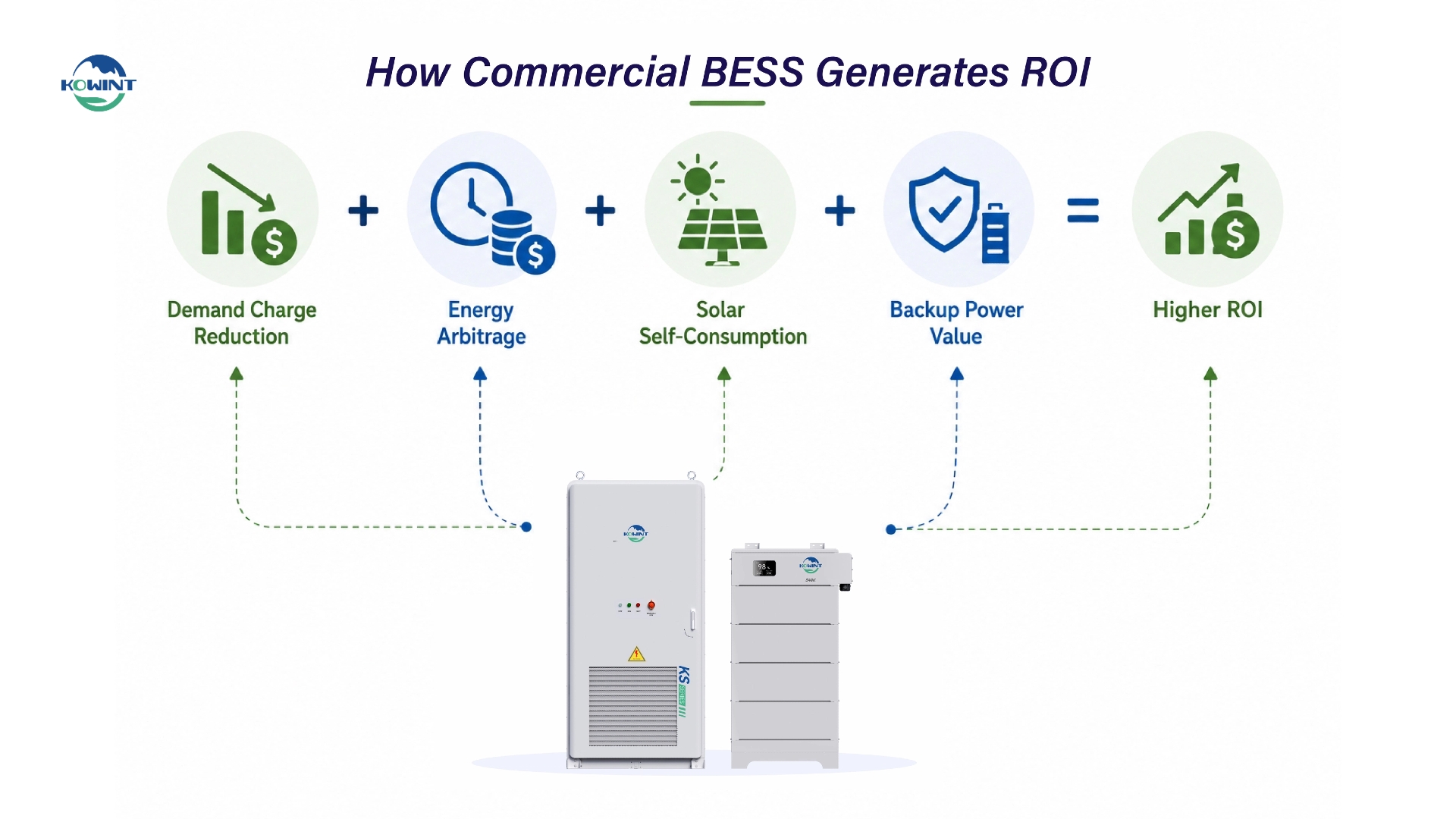
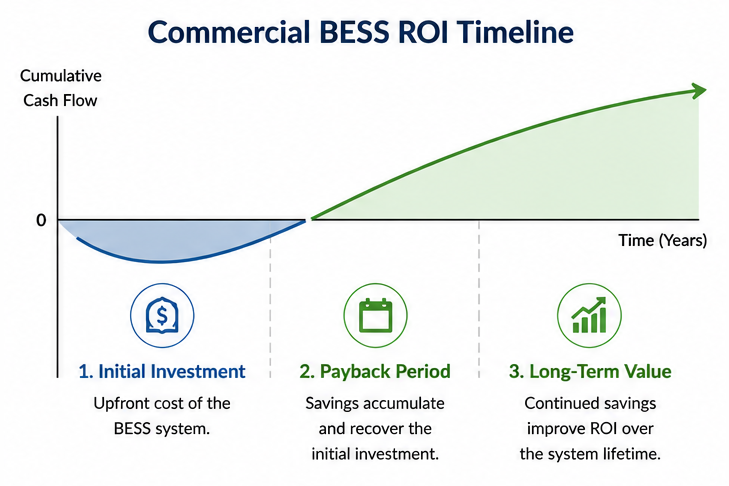
The ROI of a commercial battery energy storage system comes primarily from reducing electricity-related operating costs. Unlike traditional equipment investments that generate direct revenue, BESS typically improves financial performance by lowering energy expenses and optimizing electricity usage.
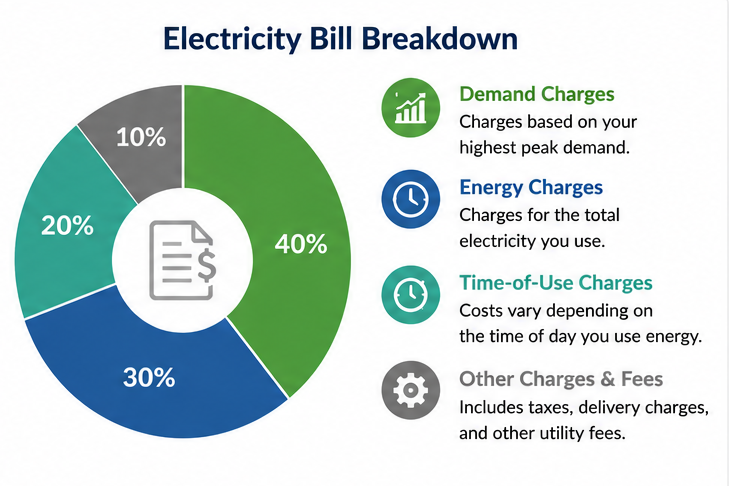
The most common source of savings is demand charge reduction. Many commercial utility tariffs include charges based on the highest level of power demand during the billing cycle. Even short-duration demand spikes can significantly increase monthly electricity bills.
By discharging stored energy during these peak periods, a BESS reduces the amount of power drawn from the grid. This process, commonly known as peak shaving, can substantially lower demand charges and improve monthly energy cost predictability.
In regions with time-of-use pricing, BESS can also generate savings through energy arbitrage. The battery charges when electricity prices are lower and discharges when electricity prices increase, reducing overall electricity procurement costs.
For facilities with on-site solar generation, energy storage further improves ROI by increasing solar self-consumption. Instead of exporting excess solar energy to the grid at lower compensation rates, businesses can store and use that energy during higher-value periods.
2. What Factors Affect Commercial BESS ROI?
The return on investment of a commercial BESS project depends heavily on site-specific conditions.
One of the most important factors is the facility’s electricity tariff structure. Sites with high demand charges typically see stronger financial returns because peak shaving delivers greater cost savings. Facilities operating under time-of-use pricing structures may also benefit from energy arbitrage opportunities.
The facility load profile also plays a critical role. Businesses with fluctuating demand patterns or short-duration power spikes generally achieve better ROI than facilities with stable and predictable loads.
Battery system sizing affects both project cost and operational effectiveness. A system with insufficient discharge power may not effectively reduce peak demand, while an oversized system may increase capital cost without proportional savings.
Control strategy is equally important. Modern energy management systems (EMS) allow the BESS to monitor facility demand in real time, predict peak events, and optimize charging and discharging schedules. Intelligent dispatch improves battery utilization and maximizes savings potential.
Project ROI can also improve when multiple value streams are combined, such as:
- Peak shaving
- Energy arbitrage
- Solar self-consumption
- Backup power support
- Demand response participation
3. Typical ROI Expectations for Commercial BESS
Commercial BESS ROI varies depending on region, application, and utility pricing. In many commercial and industrial projects, payback periods typically range between several years depending on system configuration and operating conditions.
Projects located in areas with:
- High electricity costs
- High demand charges
- Large load fluctuations
- Strong solar generation potential
often achieve stronger economic performance.
As battery technology continues to improve and electricity prices increase, the long-term value proposition of commercial energy storage is becoming more attractive across multiple industries.
4. Why Businesses Are Investing in Commercial BESS
Beyond direct electricity savings, many businesses view energy storage as a strategic infrastructure investment.
A commercial BESS improves energy flexibility and helps facilities manage increasing energy complexity caused by electrification, EV charging, renewable integration, and utility pricing volatility.
For some facilities, reducing operational risk is equally important as reducing electricity costs. Energy storage can improve resilience during grid instability and reduce the impact of short-duration outages.
As energy markets evolve, commercial energy storage is increasingly becoming part of long-term operational and sustainability planning.
About Kowint Energy
Kowint Energy provides commercial and industrial BESS solutions designed for peak shaving, demand charge reduction, and long-term energy cost optimization. Our systems support scalable deployment and intelligent energy management for commercial applications.
www.kowint.com | info@kowint.com